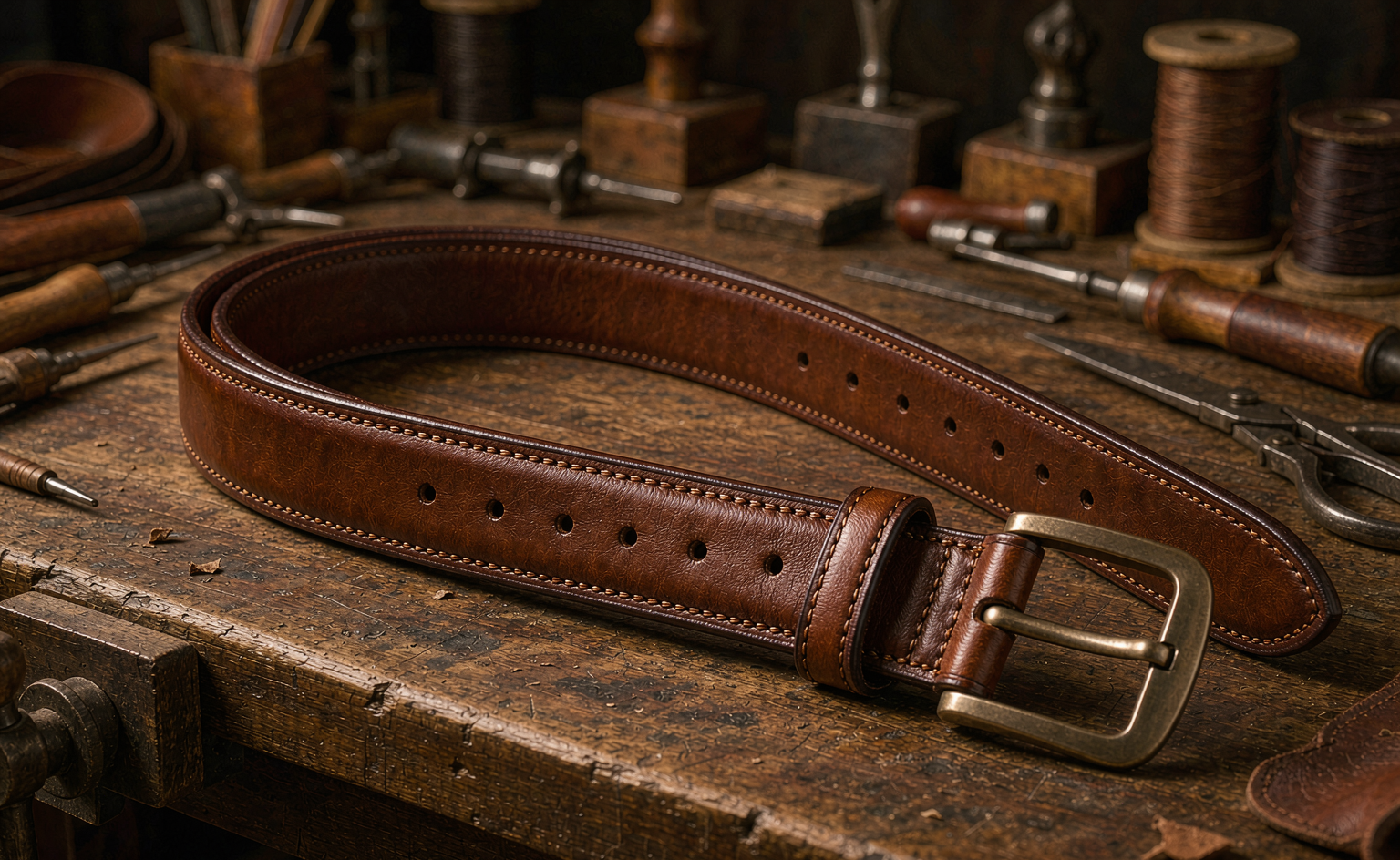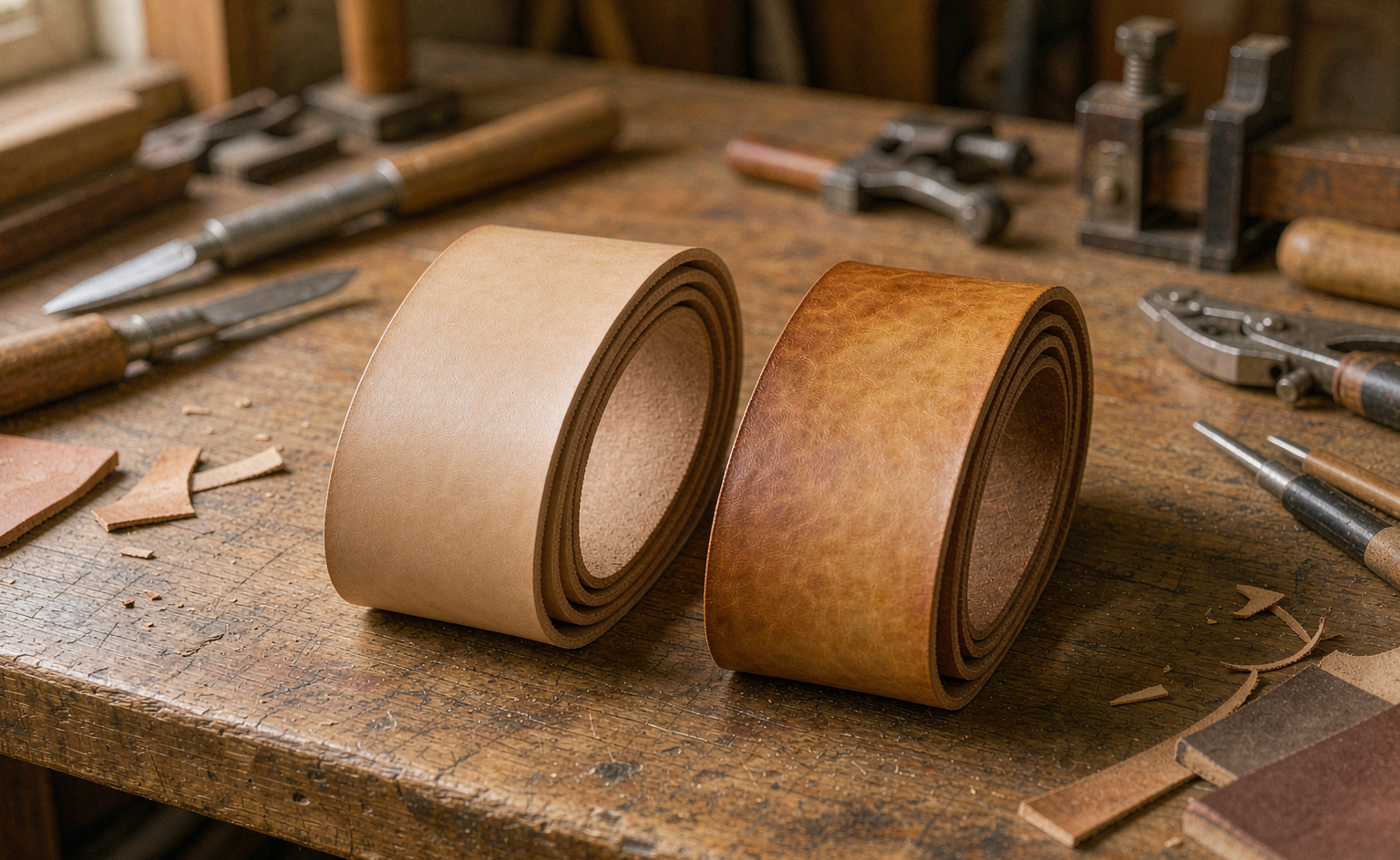
A leather belt fails for one underlying reason: the strap cannot hold the tension you put on it. Tensile strength — how much pulling force a strip of leather can resist before it stretches permanently or breaks — is governed by the hide grade, the cutting direction, the thickness, and the construction of the core. Cheap belts stretch and deform because they are made from short-fiber splits, bonded layers, or low-grade leather cut off-grain. A well-engineered belt distributes load across long, aligned collagen fibers and resists creep, sag, and elongation for years.

What Tensile Strength Actually Measures in a Belt
Tensile strength is the maximum longitudinal pull a material can withstand before it tears or ruptures. For a leather belt, the relevant number is not only the breaking point — most belts never see force that high — but the elastic limit, the load below which the strap returns to its original length once the load is removed.
A belt loaded beyond its elastic limit experiences permanent elongation. The collagen fibers slide past each other and never fully recover. That is why a cheap belt becomes a “stretchy” belt after only a few weeks: every snug cinch up overstretches the fibers past recovery, and the holes drift further apart one hole at a time.
Two numbers define a belt’s working range:
- Ultimate tensile strength — the maximum force a new strap can absorb before failure, measured in newtons (N) or pounds-force (lbf).
- Yield point — the load above which permanent stretch begins.
For daily wear, yield point matters far more than ultimate strength. A belt that yields at 800 N will stay the same length indefinitely under normal trouser-holding tension. A belt that yields at 250 N will elongate within months.
Why Cheap Belts Stretch: The Construction Problems
Most low-cost belts fail for one of four structural reasons. Each one weakens the strap in a different way.
1. Bonded Leather Instead of Full-Grain
Bonded “leather” is shredded leather fibers glued and pressed onto a fabric or polyurethane backer. It is not a continuous sheet of fiber. Under sustained tension, the glue line gives way before the fibers do, and the belt elongates in long, soft stretches rather than tearing cleanly.
2. Split Leather Cut Across the Fibers
The hide is split horizontally into layers. The top layer (grain) carries the long, aligned fibers that give leather its strength. Lower splits (the flesh side) have shorter, looser fibers. Belts cut from deep splits — even when labeled “genuine leather” — tear with far less force and stretch under lower loads than belts cut from the top.
3. Off-Grain Cutting
Collagen fibers in leather run in a primary direction along the back of the animal. A belt cut parallel to that direction carries the strongest fibers end to end. A belt cut on the bias, or perpendicular to the spine line, intersects fibers at angles that pull apart easily. Off-grain belts often look fine new and fall apart in months.
4. Thin or Hollow Cores
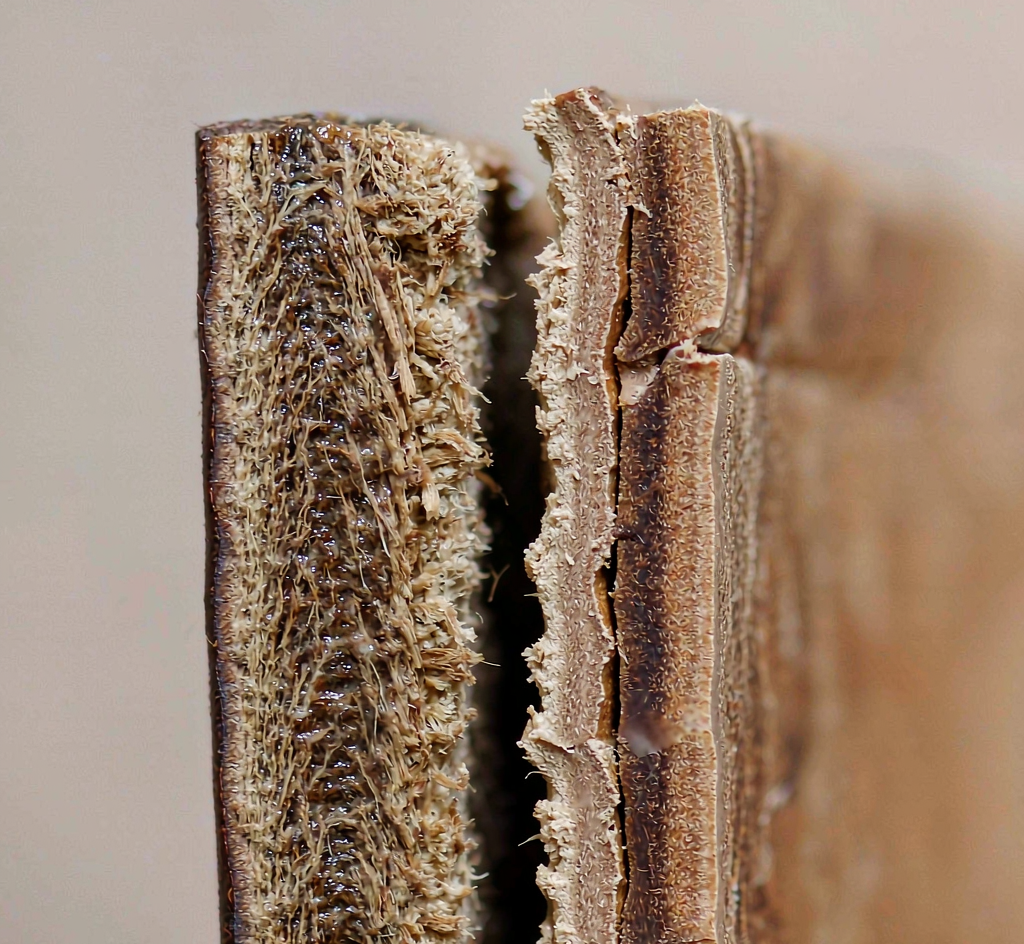
To save material, some manufacturers cut the strap below the standard 3.0–3.5 mm and rely on a stiffened core (fiberboard, plastic, or cardboard). The core looks rigid at first but lacks fiber continuity, so it cracks and crushes under repeated flexing. Once the core fails, the entire strap loses dimensional stability.
Hide Grade, Fiber Direction, and Layer Selection
Tensile strength scales directly with three hide-level factors. Understanding them lets you read a sample without a lab.
- Hide grade. Full-grain leather (the outermost layer with the natural grain intact) has the longest, most densely packed fibers. Top-grain is similar but lightly buffed. Corrected-grain and split layers have progressively shorter fibers, which is why tensile strength drops sharply as you move down the stack.
- Cut direction. The spine direction of the animal hides the strongest fiber alignment. A belt cut “along the backbone” pulls in the same direction as the fibers, while a belt cut perpendicular sees mostly lateral bonds.
- Layer selection. Single-ply belts cut from one strip of full-grain leather deliver the highest fiber continuity. Laminated belts (several thinner layers glued together) introduce glue lines that become weak points under cyclic load.
For context, a strip of full-grain veg-tanned leather at 3.5 mm thickness typically breaks in the 2,500–4,500 N range depending on the animal and the section of hide. A 2 mm split will often break below 1,000 N — fine for an accessory strap, risky for a daily belt that also carries keys, a phone, or a holster.
How to Test a Belt’s Tensile Strength Before You Buy
Formal tensile testing requires a universal testing machine and properly conditioned samples (ISO 3376 is the leather-specific standard), but you can eliminate the obvious failures with three quick field checks.
- Look at the grain. Hair cell pattern should run continuously along the length of the strap. If you can see the print of a pressed grain or a smooth, even surface with no pores, the material has been heavily coated — usually a sign of a lower-grade hide.
- Bend it. Bend the strap sharply with the grain side out. Good leather shows fine, even wrinkles. Bonded or heavily finished leather shows wide, smooth cracks or delamination at the fold line.
- Smell and feel. Real leather has a distinctive fibrous feel; bonded leather feels plastic and smells of glue. The flesh side (underside) of a quality belt shows fibrous structure, not a fabric mesh or film backing.
These checks do not replace lab data, but they are enough to filter out the majority of belts that will stretch and deform within a season.
What Spec Sheet Numbers Actually Matter
If you are sourcing belts or comparing vendors, the spec data worth asking for is straightforward.
| Specification | What it tells you | Typical range for daily belts |
|---|---|---|
| Thickness | Resistance to tear and bend fatigue | 3.0–3.8 mm |
| Ultimate tensile strength | Force at which the strap breaks | 2,000 N+ for full-grain |
| Elongation at break | How far the strap stretches before tearing | 10–30% for vegetable-tanned |
| Layer construction | Single-ply vs. laminated | Single-ply preferred for strength |
Always request values tested under ISO 3376 or ASTM D2209, and ask the supplier to confirm the cut direction (along the spine vs. across). The exact specification should be confirmed with the supplier based on your production batch and intended use — actual performance may vary according to the process setup.
Choosing a Belt That Holds Its Shape
For buyers who want a belt that does not stretch and deform, three decisions drive 90% of the outcome.
- Pick full-grain, single-ply leather. Avoid “genuine leather” labels without further clarification; they often indicate split or bonded stock.
- Confirm thickness at 3.0–3.5 mm unless you have a specific reason to go thinner.
- Source from manufacturers who cut along the spine and who can show tensile and elongation data on request.
If you need a private label belt that balances cost and durability, discuss the trade-offs openly with your manufacturer. Depending on the material and machine configuration, a slightly thicker split-construction belt may satisfy a price-sensitive SKU, while a full-grain single-ply belt will carry a premium tier. Both can be specified clearly in your tech pack.
FAQ
What is a good tensile strength for a leather belt?
A reasonable target for a daily-wear leather belt is an ultimate tensile strength above 2,000 N when tested per ISO 3376, with elongation at break kept under 30%. These figures vary by leather type, thickness, and tannage, so confirm exact numbers with your supplier for your specific spec.
Do bonded leather belts really fail faster?
Yes. Bonded leather is a composite of leather fibers and adhesive. The glue lines and short fiber length create weak points that creep and delaminate under sustained tension, so bonded belts typically elongate within weeks of regular wear.
Why does my belt get longer but never shorter?
Most leather stretching is permanent. Loads above the yield point rearrange collagen fibers without returning them to their starting positions. Once stretched, the strap holds the new length until the fibers themselves tear.
Is a thicker belt always stronger?
Not always. A thicker belt made from a deep split or with a laminated core can be weaker than a thinner single-ply full-grain belt. Thickness helps only when paired with high fiber continuity and proper cut direction.
How long should a quality leather belt last?
A well-made full-grain belt, used daily and stored on a hanger, typically holds its shape for three to five years before the holes drift noticeably. Heavier use, humidity, and waistline changes shorten that window; careful use extends it.
If you are evaluating custom leather belts for retail or private label, send your factory the target leather, the thickness window, and the cut direction you expect, and ask for tensile and elongation data per ISO 3376 with the sample. Beldtura’s custom leather belt program supports spec-driven development, allowing buyers to lock the construction before tooling is cut and avoid the stretch-failure cycle that comes with under-specified straps.