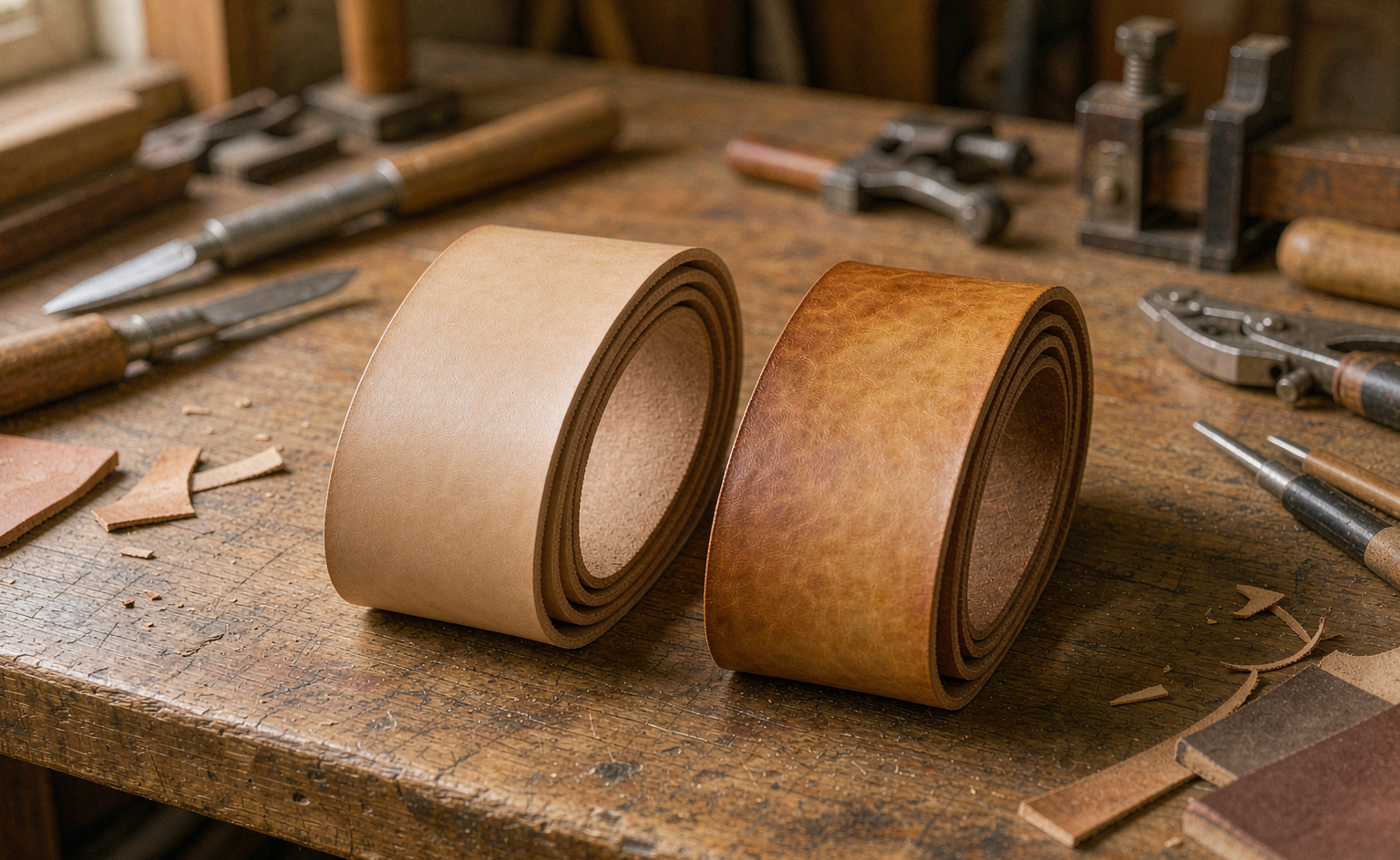
A luxury belt rarely looks expensive by accident. Two belts cut from the same hide can differ by an order of magnitude in price, and the gap lives almost entirely in details you only notice once you know where to look: the interlining between the leather plies, the way the edges are finished, and how densely the strap is stitched. These three elements — interlining, edge inking, and thread density (SPI, or stitches per inch) — determine how a belt drapes, how its edges survive years of friction, and whether the stitching stays clean after a season of wear. This guide breaks down what each one does, what quality looks like at the workbench, and what to check when you are sourcing custom belts.
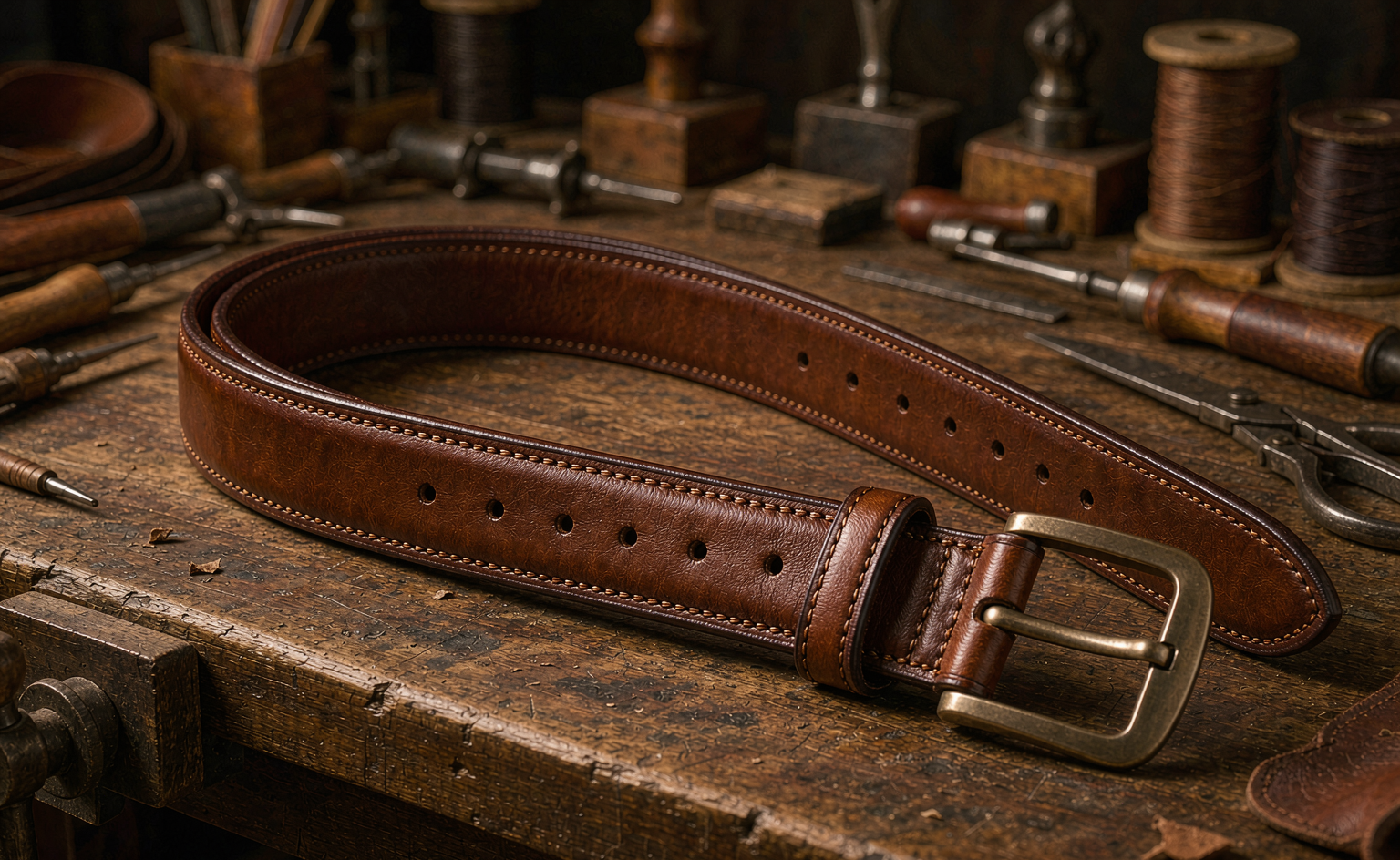
Interlining: The Invisible Structure Under the Leather
Interlining is the material laminated between the belt’s outer leather and its lining. It is invisible when the belt is finished, but it controls how the belt behaves for its entire life. Without interlining, a belt is essentially a folded or edge-joined strip that softens, stretches, and rolls at the waist. With the right interlining, the belt keeps a firm, stable body while still flexing enough to be comfortable.
Common interlining options used in belt production include:
- Fiberboard or rigid board — gives strong stiffness, commonly found in formal and uniform belts that need to hold a crisp shape.
- Non-woven or felt-backed materials — add body with more flexibility, a middle ground used when a belt must be firm but not board-like.
- Additional leather or split — a full-leather construction with no synthetic core, valued for durability and natural aging, typically stiffer to break in.
There is no universally “best” interlining — the right choice depends on the belt’s purpose and price point. What separates a quality build from a cheap one is that the interlining runs the full strap length and width, is firmly bonded without air pockets, and does not distort the outer leather during pressing. When ordering samples, ask which interlining is used and request a cross-section view; it is the fastest way to compare two suppliers honestly.
Edge Inking and Edge Painting: The Belt’s Most Visible Wear Point
The edge of a belt sees more abrasion than any other surface — it rubs against trouser loops, holster clips, table edges, and car seat seams daily. How that edge is finished decides whether the belt still looks refined after six months or starts showing raw leather and scuffs.
Two distinct techniques matter here:
- Edge inking — dye is applied directly into the cut leather edge so the color penetrates the fibers. Inked edges look natural and age gracefully, but they do not provide a protective coating.
- Edge painting — a pigmented coating (often built up in multiple layers) is applied over the edge and polished. Painted edges give a smooth, lacquered look and seal the edge against moisture and dirt. Higher-end work uses several thin coats, sanded between layers, rather than one thick coat that chips quickly.
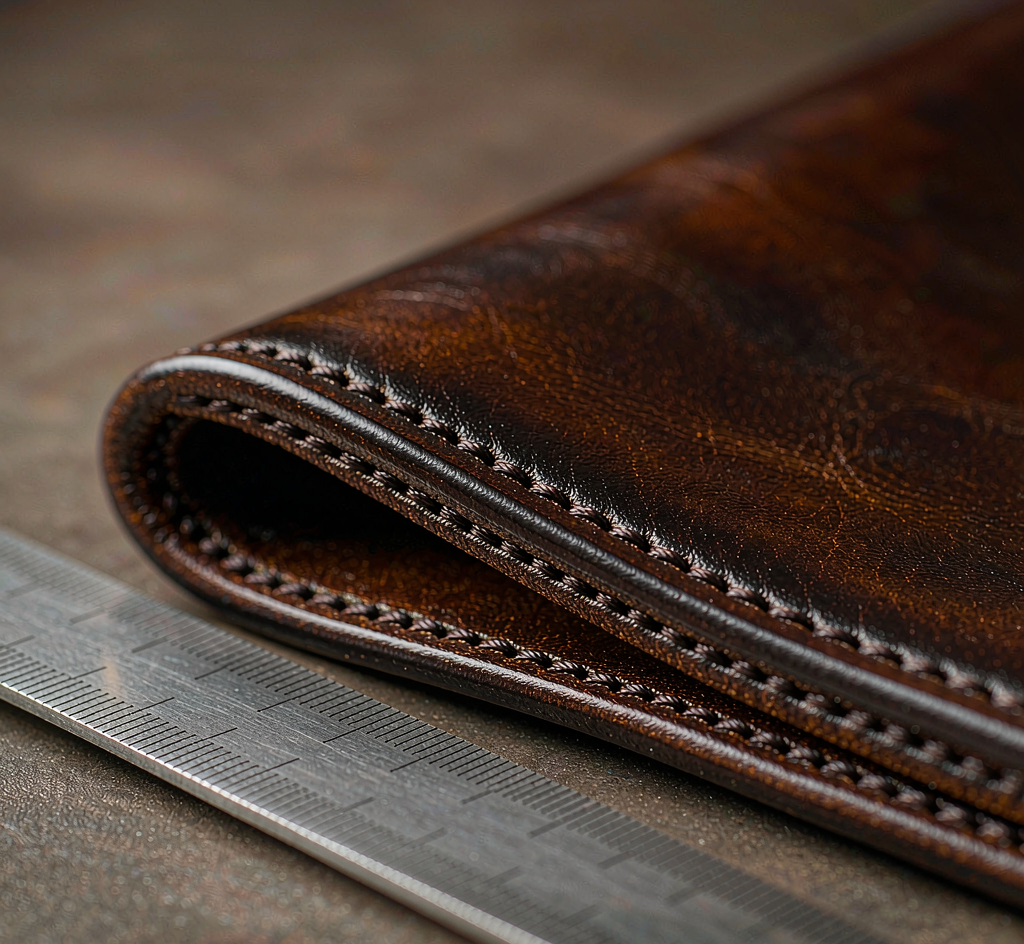
Quality signals to check: the color should match the leather exactly, coverage should be even with no thin spots at the buckle fold, and painted edges should feel smooth rather than tacky or brittle. On belts with contrasting edge color, look carefully at the transition line — sloppy taping shows up as bleed onto the surface leather.
Thread Density (SPI): Counting Stitches per Inch
SPI — stitches per inch — is one of the most objective quality metrics on a belt. Denser stitching means more stitches share the load, which usually translates to stronger seams and a finer, more elegant look. Luxury belts commonly run in the range of 7 to 10 SPI, while heavier utility belts may use 5 to 6 SPI with thicker thread for a more rugged appearance.
But density alone is not quality. Three factors must stay in balance:
- Thread thickness vs. needle size: the thread should fill the needle hole cleanly. Oversized holes with thin thread leave a sloppy, “railroad track” look as the seam stretches.
- Tension consistency: uneven tension causes visible puckering along the strap — a defect that appears only when the belt flexes, not when it lies flat on a table.
- Stitch alignment: on double-needle belts, the two stitch lines should run parallel to the edge at consistent distances, and the stitch pattern on the reverse should be as clean as the face.
When you receive samples, count the stitches over one inch on several sections of the strap, then flex the belt and inspect the seam for puckering. A belt with clean, dense, even stitching is rarely hiding other quality shortcuts, because it demands slow, disciplined machine work.
How the Three Details Work Together
Interlining, edges, and stitching are not independent upgrades — a luxury belt is a system. A stiff interlining without dense stitching tends to develop seam strain at stress points. Fine edge painting without careful inking underneath can chip to reveal unfinished leather. And high SPI on soft leather with no interlining produces a floppy belt with beautiful stitching and no structure.
The hierarchy that matters in practice: structure first (interlining), protection second (edge finish), refinement third (stitching). If a supplier handles all three competently, the belt will drape correctly, keep its edges clean, and hold its seams — the combination buyers actually feel when they pick the belt up.
What to Specify When Ordering Custom Luxury Belts
If you are sourcing a belt line, put these details in the spec sheet rather than leaving them to the factory’s discretion:
- Interlining type and thickness, and whether it must run the full strap length.
- Edge treatment: inked, painted, or both, plus the expected number of paint layers if painted.
- Thread type (polyester, nylon, bonded), thread thickness, and target SPI.
- Acceptable tolerances for stitch alignment and edge color matching, defined on the physical sample.
Working with a manufacturer that produces custom leather belts in-house means these variables can be adjusted on real samples instead of discussed in the abstract. A typical development round at a full-service supplier like Beldtura Leather — a Dongguan OEM/ODM factory serving 1000+ brands since 2007 — includes prototyping both standard and upgraded constructions so the difference in hand feel, edge finish, and stitch quality is visible before you commit to a production run.
Conclusion
The anatomy of a luxury belt is mostly invisible. Interlining gives the belt its body, edge inking and painting protect its most abused surface, and thread density determines how cleanly the whole assembly holds together. Judge samples on these three points — request a cross-section, flex the strap, and count the SPI — and you will reliably separate a genuinely well-made belt from one that only looks premium from a distance.
Ready to compare constructions side by side? Send your specifications or a tech pack for a prototype round and put these details to the test on physical samples.
What does interlining do in a belt?
Interlining is the material layer between the outer leather and the lining. It gives the belt body and stiffness, prevents stretching and rolling, and helps the belt hold its shape under daily wear. The same outer leather can feel completely different depending on what is underneath it.
Is edge painting better than edge inking?
Not inherently — they do different jobs. Inking colors the leather edge itself and ages naturally; painting adds a protective, polished coating. Many high-end belts use inking as a base with painted layers on top for both color depth and protection.
What is a good SPI for a leather belt?
Quality belts typically range from about 7 to 10 stitches per inch for a fine, elegant seam, while heavier or more casual belts often use 5 to 6 SPI with thicker thread. More important than the number alone is consistency: even tension, aligned stitching, and clean reverse side.
Why do some luxury belts feel stiff at first?
Firm interlining and layered construction are usually the reason. The belt softens gradually as the materials flex and mold to the wearer over the first weeks, without losing the structure that keeps it from rolling or stretching at the waist.
Can I request a specific edge color or stitch density from a manufacturer?
Yes — both are standard specification points in belt production. They should be defined in the spec sheet and locked against an approved physical sample, since edge tone and SPI are judged visually and by hand rather than by a single measurement.